


Contact us

- Contact number:0755-2708-8292
- Mobile Number:18938693455(Helen Yu)
- Enterprise Email:yw11@zldsmt.com
- Shenzhen Factory (Headquarters):Building A3, Huafa Industrial Park, Fuyong Street, Fuyuan Road, Baoan District, Shenzhen
- Nantong Factory Address:No.268 Jinchuan Road, Nantong Hi-tech Industrial Development Zone, Tongzhou District, Nantong City, Jiangsu Province
- Kunshan Factory Address:No.1318, Shuixiu Road, North Private Industrial Park, Yushan Town, Kunshan City, Jiangsu Province
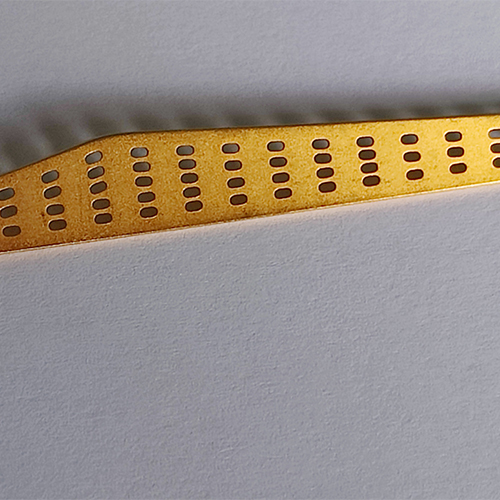
Metal spectacle frames
- Premium optical spectacles
- Japanese-style lightweight fashion eyewear
- sports protective eyewear
- shatter-resistant children's spectacles
The etching process for metal spectacle frames constitutes a precision subtractive manufacturing technique based on chemical corrosion principles, particularly suited to processing thin metal sheets with thicknesses ranging from 0.3 to 1.5 millimetres. The process sequence primarily comprises: Pre-treatment of stainless steel/titanium alloy sheets → Application of double-sided photosensitive resin coating → High-precision ultraviolet exposure → Development → Precise chemical etching → Resist removal and cleaning → Surface post-treatment. Utilising high-resolution photolithographic masks, metal spectacle frames can achieve intricate patterns with line widths as fine as 0.08mm, complex openwork areas, and locally varying depths in semi-etched structures.
The defining characteristic of this metal frame processing lies in its entirely non-contact, stress-free nature. This eliminates burrs, deformation, heat-affected zones, and internal stress accumulation inherent in traditional stamping, wire-cutting, or CNC milling. Consequently, the frames retain exceptional elasticity and fatigue resistance even in ultra-thin configurations. The etching process can be performed bilaterally in synchronisation, enabling the simultaneous formation of intricate three-dimensional features on components such as temples, frames, nose pads, and brow bridges. This particularly facilitates the creation of extremely fine decorative openwork patterns, brand logo light-transmitting apertures, and gradient thickness transitions – outcomes virtually unattainable through conventional machining.
Post-etching edges naturally form smooth rounded corners (typically ≤5μm radius), eliminating the need for subsequent deburring or chamfering. This delivers exceptionally comfortable tactile feel, avoiding the skin irritation caused by sharp edges from conventional processing. Surface roughness is controllable between Ra 0.4–0.8μm, enabling direct subsequent surface treatments such as PVD coating, anodising, brushing, or sandblasting to achieve premium finishes including mirror, matte, or coloured effects. Metal eyewear frame processing exhibits exceptional material adaptability, accommodating virtually all metals commonly used in spectacles: 304/316 stainless steel, pure titanium, beta titanium, nickel silver, cobalt-chromium alloys, etc. Even high-hardness, high-elasticity titanium alloys can be etched to a high standard.
A further distinct advantage of metal eyewear frame etching lies in its exceptional design flexibility and minimal tooling costs. Production requires only photolithographic masks (film or glass plates), with design modifications achieved through simple pattern updates without tooling changes. This makes it particularly suited for high-end bespoke eyewear production involving small batches, diverse styles, and rapid iterations. During mass production, metal spectacle frames exhibit exceptional dimensional consistency, with tolerances maintained within ±0.02mm. This meets the stringent precision requirements of international luxury brands. Furthermore, the etching process offers high production efficiency, particularly for large-area thin-sheet batch manufacturing, where unit costs are significantly lower than CNC machining per piece.
In practical production, metal frame etching enables functional structural enhancements. Examples include locally thinning the nose pad area for greater flexibility, incorporating ventilated cut-outs on the temple tips to reduce weight, and etching concealed hinge mounting slots at the brow bridge. These intricate designs directly elevate the eyewear's wearability and functionality. Overall, chemical etching offers a manufacturing pathway for metal spectacle frames characterised by high precision, zero defects, lightweight construction, artistic expression, and exceptional consistency. It has become the core processing technology enabling the pursuit of ultimate design and unparalleled comfort within the modern high-end eyewear industry.
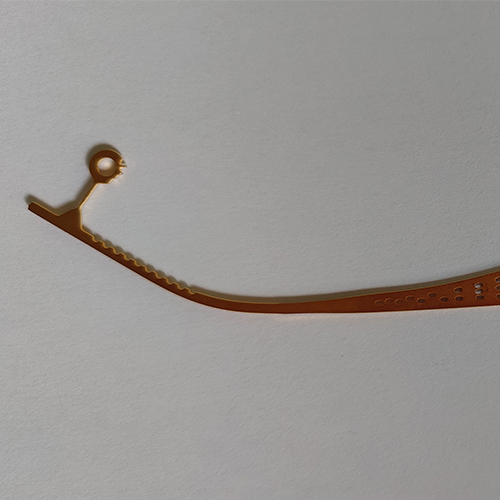
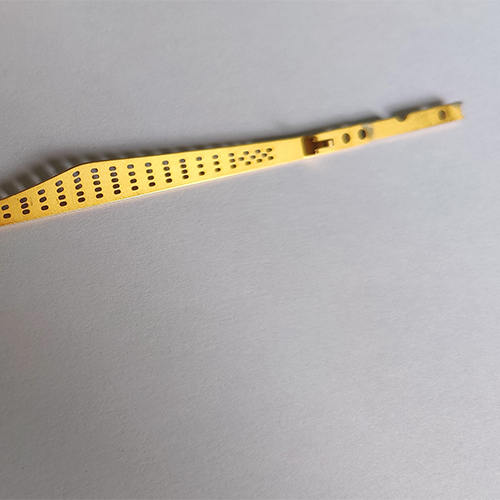
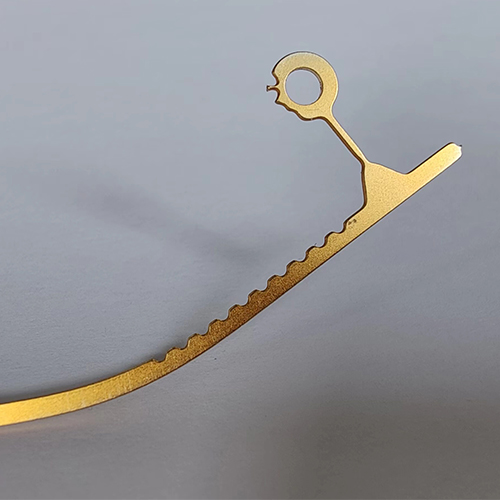
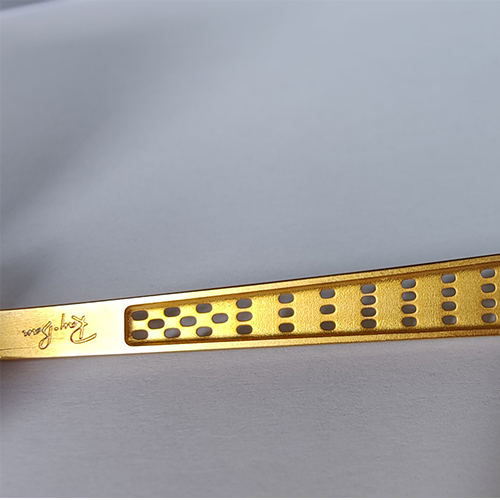
Metal spectacle frames manufactured using chemical etching offer significant comprehensive advantages over traditional stamping, CNC machining, or laser cutting. Firstly, the absence of tooling requirements enables low-cost design modifications with short lead times, making it highly suitable for high-end eyewear brands pursuing small-batch, multi-style production and rapid market launch strategies. Secondly, the processing involves no mechanical force or thermal input, preserving the material's inherent elasticity and fatigue resistance. This eliminates common stamping issues like warping and springback, whilst also avoiding the heat-affected zones and oxidation discolouration associated with laser cutting. Consequently, frames maintain their shape and colour integrity over time.
Metal frame etching achieves extraordinary structural complexity and precision, enabling designs with 0.08mm line widths, localised partial etching, dual-sided patterns, and gradient thicknesses completed in a single operation – a level of accuracy and design freedom unattainable through mechanical processing. Post-etching edges exhibit naturally rounded profiles (R ≤ 5μm), eliminating deburring processes and yielding an exceptionally smooth tactile feel with skin affinity. This effectively reduces allergy risks and wearing discomfort. Concurrently, the high surface flatness and consistency of metal frames enhance adhesion for subsequent surface treatments (e.g., PVD, anodising), delivering more uniform and durable colouration.
In industry applications, metal spectacle frames are extensively used in Japanese ultra-light pure titanium spectacles, premium European and American designer frames, sports functional eyewear, children's safety spectacles, and medical corrective lenses. Japanese lightweight eyewear brands extensively employ metal frame etching to achieve ultra-thin rims (0.4–0.8mm) and openwork ornamentation, reducing weight while maintaining sufficient strength for virtually imperceptible long-term wear. Premium fashion eyewear brands leverage etching to create highly artistic openwork patterns, brand-specific logo light-transmission designs, and gradient visual effects, establishing a key competitive edge.
Within sports and protective eyewear, metal frame processing enables integrated ventilation arrays, localised flexible thinning, and reinforced structural elements. This enhances breathability, impact resistance, and wear stability. Children's eyewear prioritises rounded edges and ultra-lightweight properties, significantly reducing collision risks. Within the medical sector, metal frame etching is employed for producing strabismus training glasses and polarised corrective frames, demanding exceptional dimensional precision and biocompatibility. The stress-free nature of etching precisely meets these requirements.
Furthermore, certain luxury eyewear brands combine metal frame etching with precious metal plating and gemstone inlay, creating limited-edition products that harmonise artistic expression with functionality. Overall, metal eyewear frame etching has become a core manufacturing technique in the high-end eyewear industry, enabling ultimate thinness, aesthetic perfection, and unparalleled comfort. Its advantages—ultra-high precision, burr-free finish, ultra-thin lightweight construction, high design flexibility, and exceptional wear comfort—have propelled eyewear from functional items to fashionable works of art.
Customer we are doing our best to provide our bestservices to our customers with competitivetech solutions and high quality products,Zhuolida has won wide recognition from ourcustomers in all kinds of industry, andthis have laid a solid foundation for Zhuolida to be an leading brand in etchingindustry in China and a reputablemanufacturer |  |
 | Technology Zhuolida is an etching factory in China with varietiesof process, our company process techniques includechemical etching, laser cutting, EDM, stampingelectroforming, electroplating, electrophoresis. |
Enviroment We have self-built sewage treatment system,the wastewater reuse rate reaches 40% |  |

 Online Inquiry
 Phone Contact