


Contact us

- Contact number:0755-2708-8292
- Mobile Number:18938693455(Helen Yu)
- Enterprise Email:yw11@zldsmt.com
- Shenzhen Factory (Headquarters):Building A3, Huafa Industrial Park, Fuyong Street, Fuyuan Road, Baoan District, Shenzhen
- Nantong Factory Address:No.268 Jinchuan Road, Nantong Hi-tech Industrial Development Zone, Tongzhou District, Nantong City, Jiangsu Province
- Kunshan Factory Address:No.1318, Shuixiu Road, North Private Industrial Park, Yushan Town, Kunshan City, Jiangsu Province
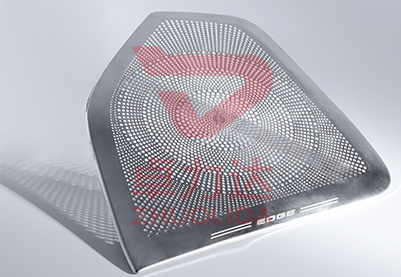
New Energy Vehicle Speaker Grille
- It is applied in the on-board audio systems of new energy vehicles (speaker positions on car doors
- center consoles
- trunks
- A/B pillars)
- audio-visual systems of new energy commercial vehicles
- protective components of intelligent cockpit speakers a
The precision etching processing of new energy vehicle speaker grilles is a customized processing technology built for the high requirements of on-board parts. The whole process adopts an automated production line operation to realize full-process precision control from substrate selection to finished product delivery. Before processing, substrates such as stainless steel and aluminum alloy are subjected to precision leveling and cleaning to ensure no impurities and deformation on the substrate surface, laying a solid foundation for subsequent etching. During processing, imported LDI exposure machines are used to complete precise pattern transfer with an exposure accuracy of ±5μm, which can accurately restore the complex hole layout in the design and solve the problems of hole position offset, edge burrs and substrate deformation that are prone to occur in the traditional stamping process.
The etching process adjusts the concentration, temperature and etching time of the etching solution through computer program control to achieve micron-level processing precision. The tolerance of the hole size can be controlled within ±0.01mm, and the hole walls are vertical and smooth without defects such as edge collapse and slag hanging, perfectly matching the acoustic transmission requirements of on-board audio. In response to the lightweight demand of new energy vehicles, the etching process can realize the precise processing of ultra-thin substrates (0.1mm) and produce grilles of different patterns and sizes without mold opening, which greatly shortens the new product development cycle and adapts to the characteristics of fast model renewal and high customization of new energy vehicles. After processing, the products are subjected to multiple cleaning, drying and testing, and full-size inspection is completed by automatic image measuring instruments to ensure uniform mesh structure and precise hole positions. At the same time, subsequent surface treatment can be carried out according to customer requirements to make the products have both corrosion resistance and aesthetics.

In the field of new energy vehicle parts processing, compared with traditional stamping and laser cutting processes, the precision etching process brings multiple core advantages to the production of speaker grilles and has become the preferred processing method for new energy vehicle OEMs and supporting suppliers. The etching process requires no mold opening, and the customization of grilles with different patterns and sizes can be completed only by modifying the design drawings. The development cycle is shortened from 15-30 days of the traditional process to 3-7 days, which perfectly adapts to the industry characteristics of fast model iteration and high customization demand of new energy vehicles, and greatly reduces the time and capital cost of new product development. At the same time, the etching processing has no mechanical stress, will not cause substrate deformation and warpage, and the processed grille has high flatness and can be directly assembled without subsequent shaping, solving the problems of reduced product precision and excessive assembly clearance caused by mechanical extrusion in the stamping process, and improving the assembly efficiency of parts.
In terms of precision and consistency, the etching process can achieve micron-level processing, with both hole precision and hole position deviation controlled within ±0.01mm. The uniform mesh structure results in sound transmittance consistency far exceeding that of traditional processes, which can accurately match the acoustic design standards of the intelligent cockpit of new energy vehicles and ensure the sound quality and effect of the audio system. In response to the lightweight trend of new energy vehicles, the etching process can process ultra-thin metal substrates of 0.1mm, which greatly reduces the product weight while ensuring the protective performance, meeting the demand of the whole vehicle for weight reduction and range improvement. It can also process lightweight materials such as aluminum alloy to further optimize the product weight. In addition, the etching process can realize the integrated processing of complex special-shaped patterns without subsequent splicing, resulting in a strong product integrity. At the same time, the burr-free surface and smooth edges avoid the heat-affected zone problem of the laser cutting process, improve the aesthetics and safety of the product, and are more in line with the high-quality requirements of automobile interior decoration.

 Online Inquiry
 Phone Contact