


Contact us

- Contact number:0755-2708-8292
- Mobile Number:18938693455(Helen Yu)
- Enterprise Email:yw11@zldsmt.com
- Shenzhen Factory (Headquarters):Building A3, Huafa Industrial Park, Fuyong Street, Fuyuan Road, Baoan District, Shenzhen
- Nantong Factory Address:No.268 Jinchuan Road, Nantong Hi-tech Industrial Development Zone, Tongzhou District, Nantong City, Jiangsu Province
- Kunshan Factory Address:No.1318, Shuixiu Road, North Private Industrial Park, Yushan Town, Kunshan City, Jiangsu Province
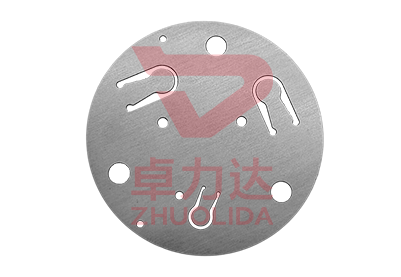
Etched Stainless Steel Valve Plate
- Etched stainless steel valve plates are widely used in automotive fuel injection systems
- compressor valve plates (e.g.
- air compressors)
- high-temperature and high-pressure valves in petrochemical industry
- micro-valves in medical devices
- aerospace
The etching processing of stainless steel valve plate is a precision manufacturing technique that uses chemical solutions to selectively dissolve metal, especially suitable for processing thin parts with thicknesses from 0.02 to 1.5 mm. The entire process includes material cleaning, photoresist coating, UV exposure, development, chemical etching, stripping, and cleaning. Through photomask control, corrosion occurs only in designated areas, enabling precise graphic patterning and high-accuracy forming of stainless steel valve plate.
One of the most significant features of stainless steel valve plate processing is that it is a non-contact process, avoiding burrs, stress deformation, and heat-affected zones commonly associated with traditional mechanical stamping or cutting. This ensures that stainless steel valve plate retains the original elasticity and mechanical properties of the material without change.
During the etching of etched stainless steel valve plate, the etchant is uniformly sprayed or the part is immersed, with controllable etch rates typically achieving micron-level precision. Both double-sided and single-sided etching are possible, allowing for half-etch (different depth structures) or through-hole designs — capabilities that stamping processes struggle to match. After etching, stainless steel valve plate edges naturally form smooth rounded corners (radius ≤ 3 μm), with surface roughness Ra ≤ 0.8 μm, eliminating the need for additional deburring or polishing, significantly shortening production cycles and reducing costs. Stainless steel valve plate processing is not limited by material hardness, brittleness, or shape complexity, and is suitable for various stainless steel grades (e.g., 304, 316L, 317, etc.), particularly high-corrosion-resistant grades containing molybdenum.
Another outstanding feature of etched stainless steel valve plate is its high repeatability and consistency. In mass production, dimensional variation between parts is extremely small, making it ideal for high-reliability, large-volume applications. Etching offers high production efficiency — especially for large-area thin sheets — with capacity far exceeding laser or wire cutting, while mold development cost is virtually zero. Only a photomask is needed, allowing rapid design iterations with lead times as short as a few days. Stainless steel valve plate can achieve micro-hole arrays, precision channels, or irregular contours through etching, with tolerances reaching ±0.01 mm, meeting the stringent flow control and sealing requirements of high-end valves.
Additionally, stainless steel valve plate processing involves no mechanical force, resulting in high part flatness and no residual internal stress, leading to longer service life. In petrochemical, medical, and automotive industries, the processing characteristics of etched stainless steel valve plate directly determine valve reliability and stability, preventing flow path blockage or sealing failure issues common in traditional machining. Overall, etching technology provides stainless steel valve plate with a high-precision, defect-free, high-efficiency manufacturing solution and has become one of the mainstream technologies for modern precision metal component production.
Etched stainless steel valve plate manufactured via chemical etching offers significant advantages over traditional stamping, laser cutting, or CNC machining. First, no mold development is required, resulting in low cost and high design flexibility — especially suitable for small-batch, multi-variety production or rapid prototyping. Second, the etching process for stainless steel valve plate is free of thermal effects and mechanical stress, preserving the material’s excellent elasticity and fatigue resistance, avoiding warping and deformation issues common in stamping, and ensuring long-term stability during repeated opening and closing cycles. Stainless steel valve plate processing achieves extremely high precision (±0.01 mm) and burr-free smooth edges with superior surface quality, greatly improving sealing performance and fluid control accuracy.
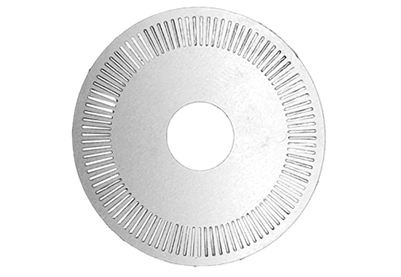
Another key advantage of etched stainless steel valve plate is its ability to form complex structures in a single process, easily producing micro-holes, louver-style channels, or discontinuous patterns — features difficult to achieve with mechanical machining. The process is environmentally friendly (etchant can be recycled), offers high production efficiency, excellent batch consistency, and reduced defect rates and rework costs. Compared to laser cutting, stainless steel valve plate etching produces no heat-affected zone or oxide layer, resulting in cleaner edges; compared to stamping, it requires no expensive tooling and is not limited by material thickness, offering broader applicability.
In terms of industry applications, stainless steel valve plate is widely used in automotive fuel injection systems and ABS brake systems as precision control elements for accurate flow regulation. Stainless steel valve plate processing is particularly prominent in the compressor field (e.g., air compressor valve plates), where high elasticity and sealing performance are required — etching ensures perfect conformity between valve plate and seat for stable long-term performance. In the petrochemical industry, etched stainless steel valve plate is applied in high-temperature, high-pressure valves; its micro-hole structures enable precise control of corrosive fluid flow while avoiding blockage or leakage risks associated with mechanical machining. In the medical device sector, stainless steel valve plate is used in micro-valves, components related to cardiac stents, or microneedle arrays, where biocompatibility and high cleanliness are critical — the stress-free nature of etching ensures safety.
Aerospace hydraulic control systems also extensively use stainless steel valve plate to maintain reliable sealing and response speed under extreme conditions. Furthermore, in semiconductors, precision instrumentation, and other fields, stainless steel valve plate processing supports complex fluid channel designs, enhancing equipment performance. In summary, thanks to its comprehensive advantages of high precision, defect-free characteristics, and corrosion resistance, etched stainless steel valve plate has become a core component in high-end industries such as automotive, compressors, petrochemicals, medical devices, and aerospace, driving advancements in precision fluid control technology.


 Online Inquiry
 Phone Contact